
Alternative configuration
New-Type Organic Fertilizer Granulator
Forms conditioned fertilizer feed into market-ready granules with a selected shaping mechanism.
View details → Get a Proposal
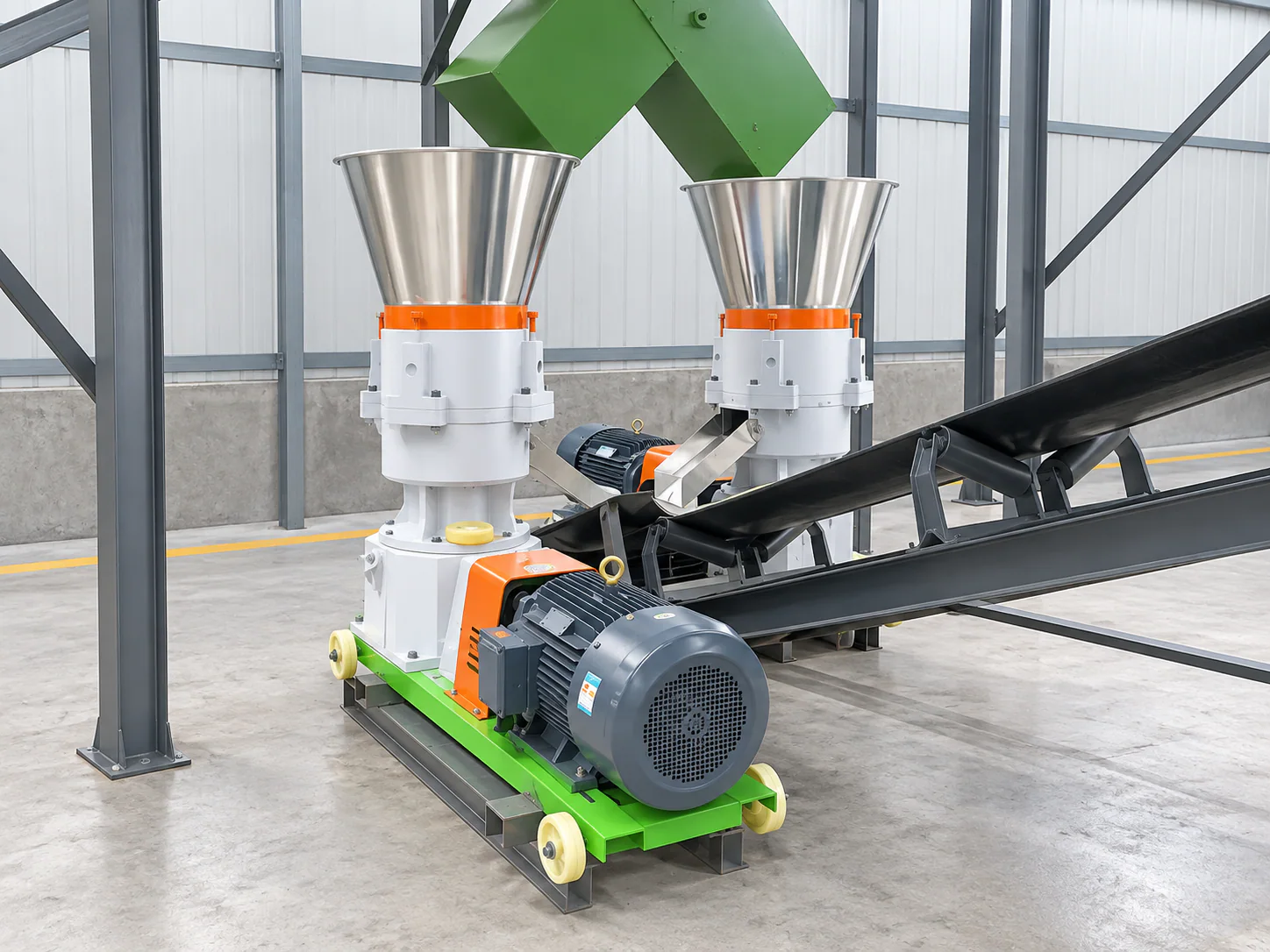
Flat die and roller compacting fines; die change sets pellet diameter. Selection is based on the material, capacity and connected process—not a catalogue number alone.
Selected for the real material
Matched upstream and downstream
Access and wear parts considered
Interlocks planned with the line
Installation and commissioning scope
Forms conditioned fertilizer feed into market-ready granules with a selected shaping mechanism. The machine is engineered around the actual duty so material residence, transfer and control logic stay compatible with the next stage.
Final model, motor, dimensions and wear configuration should be issued only after feed tests or a documented material review.
The inlet stabilizes the duty.
Operating settings are tuned to the real feed.
Operating settings are tuned to the real feed.
Operating settings are tuned to the real feed.
Operating settings are tuned to the real feed.
The outlet is matched to downstream handling.
The referenced website does not publish an exact matching model table for this product name.
No exact matching public model table was found on the referenced website for this product name. Capacity, power, dimensions, weight, material-contact parts and utility load remain controlled proposal fields and will be issued with the selected model.
Feed auger into the die chamber, with steam or water added just before the die so the mix reaches working plasticity.
Flat die with rollers pressing feed through the holes; die thickness and hole diameter set pellet density and size.
Vertical shaft through a heavy gearbox, built for the pressure a full die imposes at start-up.
Knife under the die trims pellets, and a conveyor returns fines to the feed auger.
Conveying, buffers, dust control and automation are finalized with the plant layout.
Forms conditioned fertilizer feed into market-ready granules with a selected shaping mechanism.
View details →
Forms conditioned fertilizer feed into market-ready granules with a selected shaping mechanism.
View details →
Forms conditioned fertilizer feed into market-ready granules with a selected shaping mechanism.
View details →
Forms conditioned fertilizer feed into market-ready granules with a selected shaping mechanism.
View details →Model selection follows material condition, capacity, operating hours and the connected process. Send representative data or samples for confirmation.
Usually, after checking inlet and outlet height, capacity, controls, utilities, access and the duty of adjacent stages.
The confirmed proposal can include model, process duty, motor and utility data, interface dimensions, scope boundary and service plan.
Yes. Material abrasiveness, operating schedule and local service conditions are used to define wear parts and recommended spares.
Use the decision criteria before fixing a granulation or process mechanism.
Read the guide →See how the equipment connects to upstream and downstream stages.
Explore solutions →Filter cases by material, product, capacity, location and technology.
Browse cases →Published ranges support preliminary comparison; the approved proposal controls final model, power, dimensions and weight.
Share moisture, composition, output target, final product and site constraints. Our engineers will propose a practical configuration.
 +8615981847286WhatsApp
 [email protected]Email
 Please enter the contentSearch
 Click to return to the topTOP